Best A2 Bilona Ghee Brands in India (2026): An Honest, Tested Buyer’s Guide
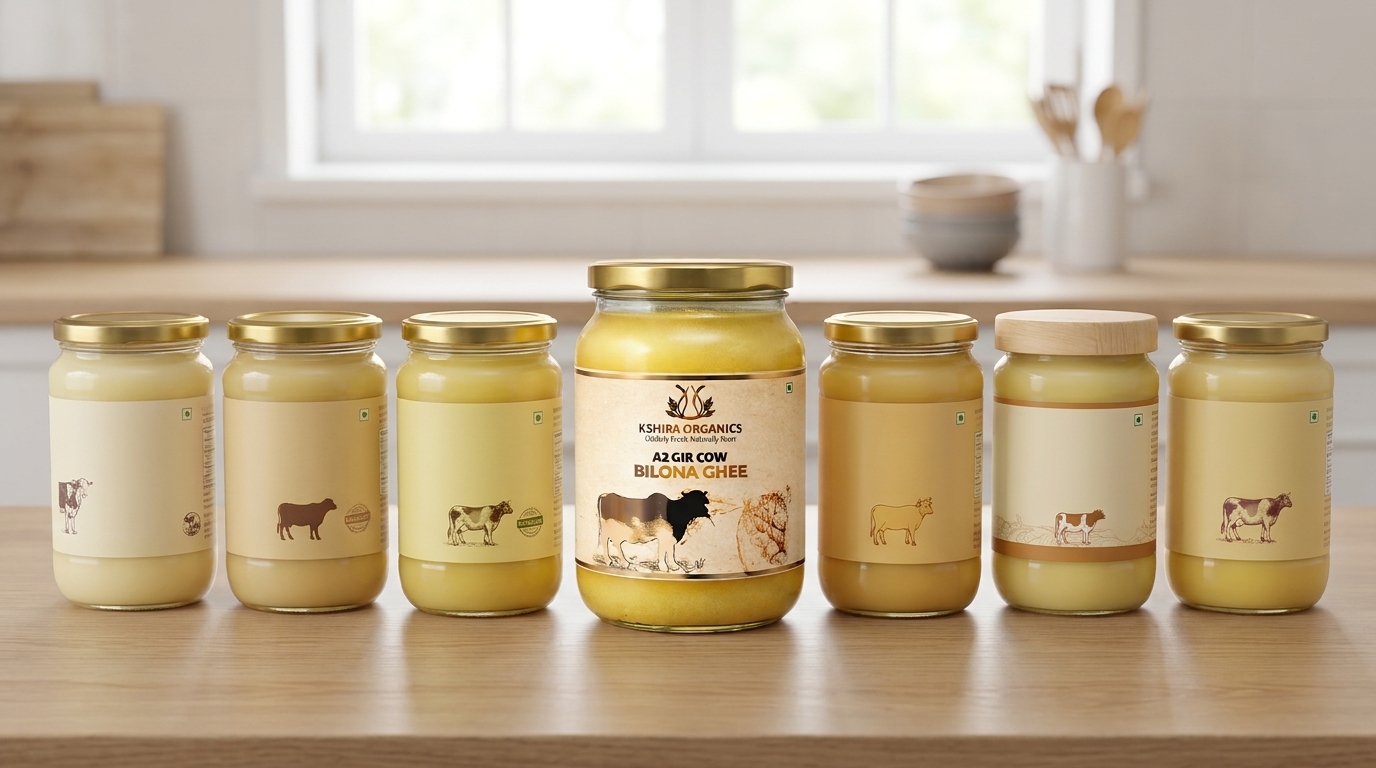
Frequently Asked Questions (FAQs) Q1: What is the main difference between A2 Ghee and Bilona Ghee? A: They refer to two completely different aspects of quality: A2 refers to the source milk: It comes exclusively from indigenous Indian cow breeds (like Gir, Sahiwal, and Tharparkar) or Murrah buffaloes, containing the non-inflammatory A2 beta-casein protein. Bilona refers to the traditional 5-step process: Milk is first set into curd overnight, hand-churned into makhan (butter), and slow-clarified into ghee over low heat. Key Takeaway: A product can be A2 without being Bilona (if made via commercial cream separation). The healthiest, most authentic ghee is both A2 and Bilona. Q2: Why is authentic A2 Bilona Ghee more expensive than supermarket cow ghee? A: The economics boil down to raw ingredients and production time: Yield: It requires 25 to 30 liters of pure A2 milk to make just 1 liter of traditional Bilona Ghee. Commercial cream-separation uses only 15 to 18 liters. Cattle Yield & Care: Indigenous pasture-raised cows yield far less milk per day (6–10 liters) compared to commercial crossbred cattle. Time: The Vedic Bilona method takes 24–30 hours of labor and curd fermentation per batch. Any product labeled "A2 Bilona Ghee" priced under ₹900 for 500ml is an economic red flag indicating shortcuts (such as cream separation or milk blending). Q3: Does A2 Bilona Ghee contain lactose or casein? A: Traditional Bilona Ghee contains virtually zero lactose and casein. The overnight curd fermentation process breaks down dairy sugars and proteins, while the low-heat clarification removes remaining milk solids. This makes authentic Bilona Ghee easily digestible, non-inflammatory, and safe for people with lactose sensitivity or mild dairy intolerance. Q4: Why does the color and grain size of Kshira Organics Ghee vary between jars? A: Natural variation is the ultimate proof of unblended, small-batch purity. Unlike mass-market brands that chemically homogenize ghee for identical color and paste-like consistency, authentic Bilona Ghee shifts naturally from pale golden yellow to light amber depending on: The seasonal pasture diet of our free-grazing cows (fresh green grass in monsoons vs. dry fodder in winter). Ambient room temperature during cooling, which dictates natural fat crystallization (danedaar texture). Q5: Can I use A2 Bilona Ghee for high-heat cooking and deep frying? A: Yes. Authentic A2 Bilona Ghee has an exceptionally high smoke point of 250°C (482°F). Because milk solids and water are removed during slow clarification, it will not break down into toxic free radicals or acrolein during deep-frying, sautéing, or tempering (tadka). Q6: What is the shelf life of Kshira Organics A2 Bilona Ghee, and does it need refrigeration? A: Pure A2 Bilona Ghee has a natural shelf life of 12 months when stored in a cool, dry place away from direct sunlight. It does not require refrigeration. Always use a clean, dry spoon to prevent introducing moisture into the jar, as moisture is the only factor that degrades ghee quality.
Read Article →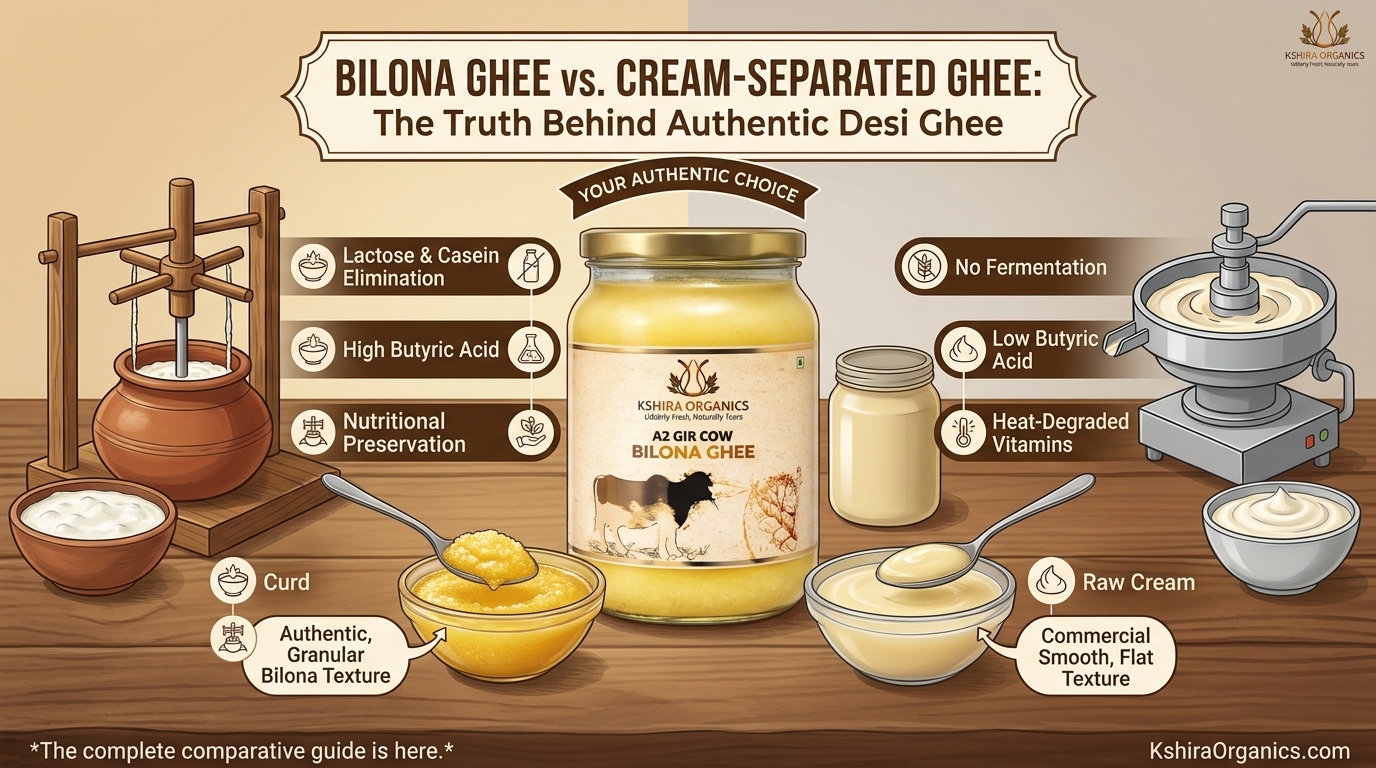
Bilona Ghee vs Cream-Separated Ghee: Differences & Health Benefits
Read Article →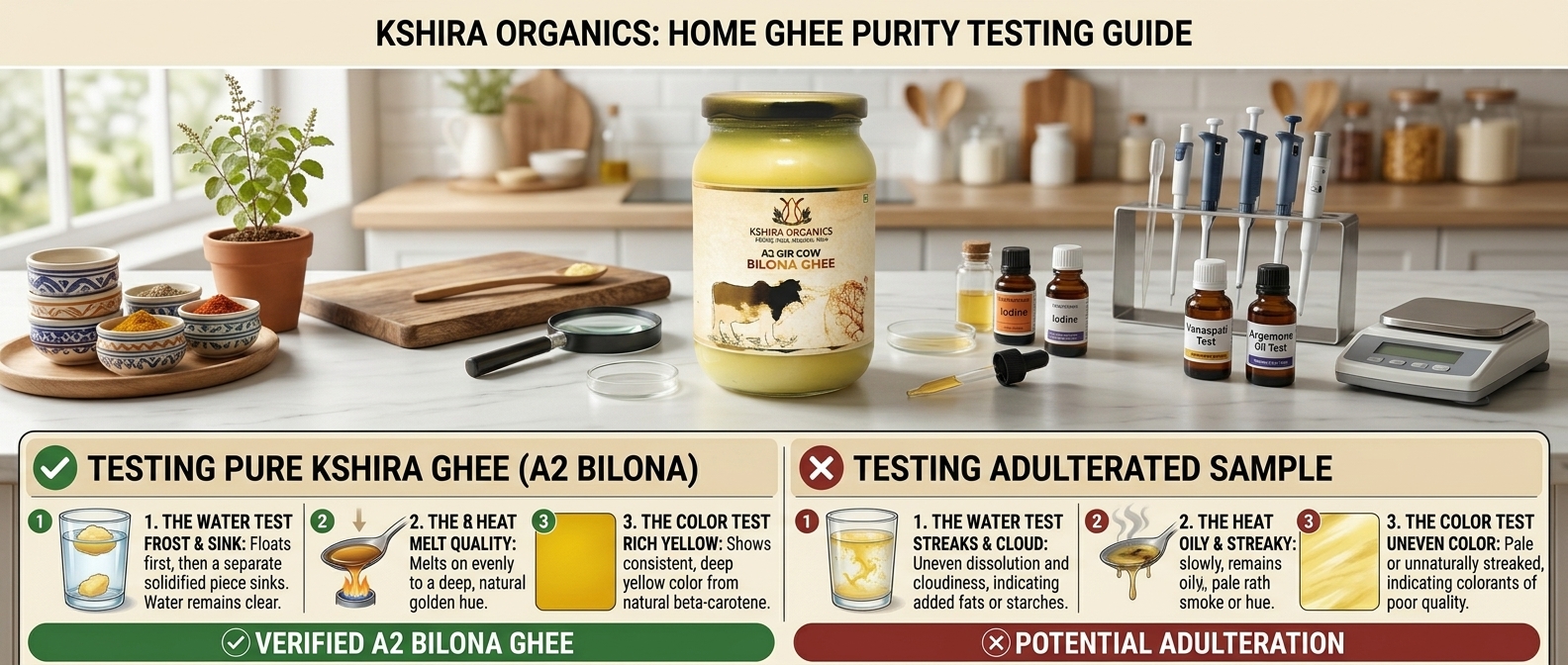
How to Check if A2 Ghee is Real or Adulterated at Home?
Frequently Asked Questions (FAQs) Why does the color or grain of authentic A2 Bilona Ghee vary between jars? Unlike mass-market brands that chemically homogenize ghee for uniform appearance, authentic small-batch Bilona Ghee naturally varies in shade (golden yellow to light amber) and grain size (danedaar texture). This variation depends on the seasonal diet of free-grazing Gir cows (fresh monsoon grass vs. winter fodder) and ambient cooking temperatures. Natural batch variation is proof of an unblended, authentic small-batch product. Is A2 Bilona Ghee safer than commercial cream-separated ghee? Yes. Traditional Bilona ghee starts with curd fermentation, breaking down lactose and casein residues while retaining fat-soluble nutrients (Vitamins A, E, D, K). Commercial cream-separated ghee processes raw milk cream (malai) through industrial centrifuges, which fails to remove fat-soluble pesticides present in mass cattle feeds.
Read Article →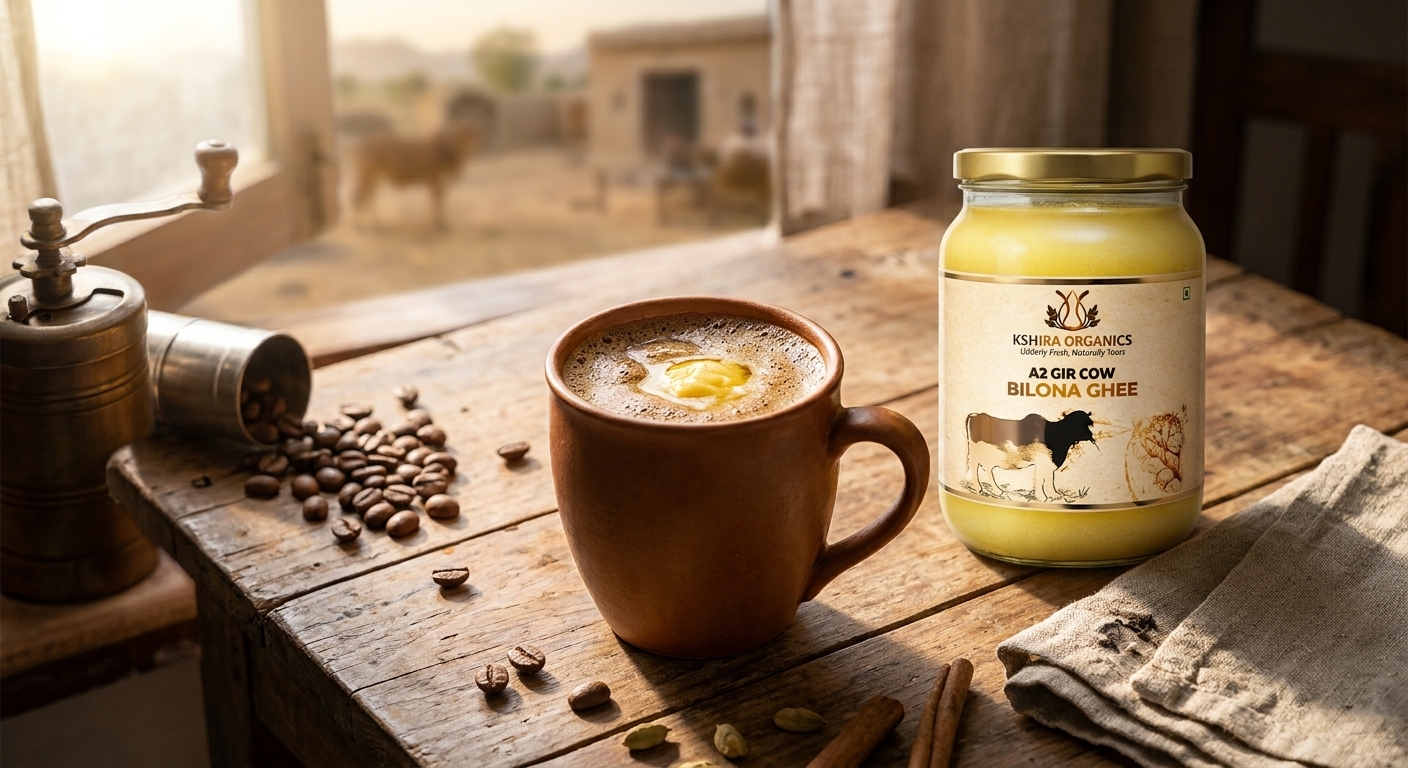
Bulletproof Coffee: Why Adding A2 Ghee to Your Morning Coffee Changes Everything
Read Article →
What is A2 Bilona Ghee? The Ultimate Guide to Purity, Process, and Health Benefits
<!-- Summary Block / Executive Overview --> <div style="background-color: #fdfbf7; border: 1px solid #e0d7c6; border-left: 5px solid #c59b27; padding: 20px 24px; border-radius: 6px; font-family: sans-serif; margin: 20px 0;"> <h2 style="margin-top: 0; color: #4a3308; font-size: 1.35em;">📌 Executive Summary: What is A2 Bilona Ghee?</h2> <p style="color: #444; line-height: 1.6; margin-bottom: 15px;"> <strong>A2 Bilona Ghee</strong> is an ancient, hand-crafted superfood made exclusively from the milk of indigenous Indian cows (such as Gir and Sahiwal) using traditional curd-churning methods. </p> <ul style="color: #333; line-height: 1.7; margin-bottom: 0; padding-left: 20px;"> <li><strong>The A2 Advantage:</strong> Contains non-inflammatory A2 beta-casein protein, making it gentle on digestion compared to commercial A1 dairy.</li> <li><strong>The Vedic Bilona Method:</strong> Whole milk is fermented into curd, churned bi-directionally with a wooden <em>bilona</em> to yield butter, and slowly clarified.</li> <li><strong>High Resource Intensity:</strong> Requires <strong>25 to 30 liters of pure A2 milk</strong> to produce just <strong>1 liter</strong> of ghee.</li> <li><strong>Key Health Benefits:</strong> Rich in gut-healing <strong>butyric acid</strong>, CLA, Omega-3s, and essential fat-soluble vitamins (A, D, E, K).</li> <li><strong>High Heat Stability:</strong> Features a <strong>250°C (482°F) smoke point</strong>, making it safe for cooking without producing toxic free radicals.</li> </ul> </div>
Read Article →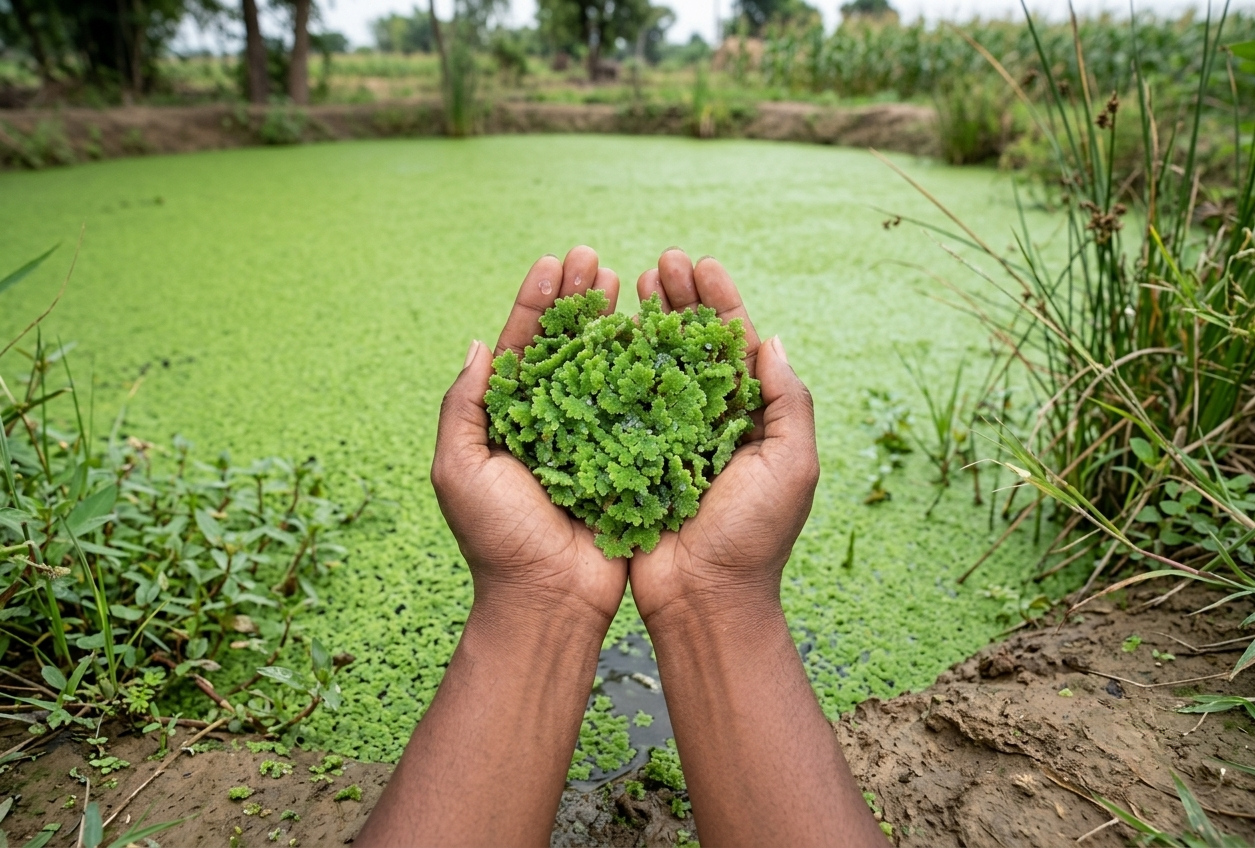
The Azolla Revolution: How This Wonder-Fern Supercharges Our Cows, Milk, and Ghee
At Kshira Organics, pure dairy starts with what our cows eat. Discover how integrating Azolla—a nutrient-dense, sustainable aquatic fern—into our cows' daily diet naturally boosts milk yield by 10% to 15%, elevates healthy Omega-3s, and packs our traditional golden Bilona Ghee with up to 30% more immunity-boosting antioxidants.
Read Article →